


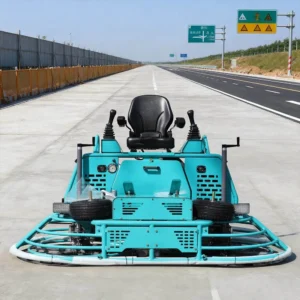
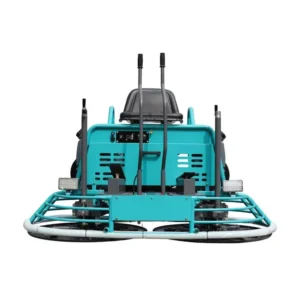
Ride-on Power Trowels JQ836-2 24HP 18.4KW Ride On Hydraulic Concrete Power Trowel
Ride-on Power Trowel, also known as a ride-on floor polisher or concrete trowel, is a large-scale professional construction equipment used for slurry raising, leveling, and polishing surfaces such as cement concrete and epoxy flooring. Compared to traditional handheld polishers, the ride-on design allows operators to work while seated directly on the machine, significantly reducing labor intensity while significantly improving construction efficiency and work precision. This equipment is primarily used in industrial and commercial flooring applications where high standards for floor flatness and finish are required, such as high-standard factories, large warehouses, parking lots, and commercial plazas.
Ride-on Power Trowel JQ836-2
Ride-on Power Trowel, also known as a ride-on floor polisher or concrete trowel, is a large-scale professional construction equipment used for slurry raising, leveling, and polishing surfaces such as cement concrete and epoxy flooring. Compared to traditional handheld polishers, the ride-on design allows operators to work while seated directly on the machine, significantly reducing labor intensity while significantly improving construction efficiency and work precision. This equipment is primarily used in industrial and commercial flooring applications where high standards for floor flatness and finish are required, such as high-standard factories, large warehouses, parking lots, and commercial plazas.
Technologically, ride-on power trowel have evolved from simple mechanical devices to intelligent equipment. Early models offered only basic finishing functions, while modern high-end units integrate advanced technologies like hydraulic transmission, pressure regulation, and dust control. These machines typically achieve work rates of 150-200 square meters per hour—over ten times faster than manual finishing. This not only drastically shortens construction cycles but also delivers superior surface quality. Machine-finished floors exhibit smoother, flatter surfaces with significantly enhanced concrete density and abrasion resistance, creating an ideal foundation for subsequent treatments like epoxy coatings or polishing.
Regarding power configuration, ride-on power trowels primarily utilize Honda gasoline engines. With 24 horsepower, these engines feature excellent heat dissipation and strong adaptability, ensuring stable performance output during prolonged continuous operation. This robust and reliable power system is the core guarantee enabling power trowels to handle large-area, high-standard construction tasks.

Use Cases
Ride-on power trowel have a wide range of applications, covering nearly all concrete construction scenarios with high demands for floor flatness and surface quality. Equipment selection and usage require targeted adjustments based on specific project characteristics and environmental conditions to fully leverage their technical advantages.
In industrial construction, ride-on power trowel are the preferred equipment for flooring in high-standard factories, large warehouses, and logistics centers. These facilities typically feature vast areas (ranging from thousands to tens of thousands of square meters) where floors endure long-term loads from heavy machinery and cargo. They impose stringent requirements on flatness (often demanding tolerances within 3mm/2m), abrasion resistance, and dustproofing. Ride-on equipment efficiently completes large-area construction, ensuring superior overall floor integrity and eliminating uneven joints caused by traditional segmented construction. Particularly in modern logistics facilities requiring ultra-flat floors (Free-flat), the equipment equipped with laser leveling systems can achieve remarkable horizontal precision (above 1mm/2m), meeting the operational requirements of high-precision logistics equipment such as automated guided vehicles .
Commercial and public facilities also extensively utilize ride-on floor grinders. Venues like shopping malls, airport terminals, and convention centers demand not only safe, level surfaces but also aesthetic appeal. By adjusting grinding disc pressure, rotational speed, and pass counts, operators can achieve diverse surface finishes—ranging from rough anti-slip textures to mirror-like smoothness. The treated substrate provides an ideal foundation for applying high-end floor coatings like epoxy and polyurethane, creating optimal conditions for subsequent decorative finishes. For outdoor plazas and pedestrian streets, these machines process various colored concrete and stamped pavements. Combined with specialized molds, they produce a wide array of decorative effects.
Transportation infrastructure represents another critical application for ride-on floor grinders. Surfaces in large parking lots, transit hubs, and toll plazas endure constant vehicular traffic and chemical exposure. Professionally ground floors exhibit high density and low porosity, effectively preventing moisture and salt penetration while significantly extending service life. Equipped with specialized edge-processing attachments, these machines access areas inaccessible to conventional equipment, ensuring uniform quality standards across entire sites. In tunnel flooring applications, dust suppression and noise reduction capabilities are particularly critical, where new eco-friendly models excel.
Specialized industrial environments demand highly tailored flooring solutions. Food processing plants and pharmaceutical facilities require seamless, easy-to-clean surfaces; electronics factories demand anti-static treatment; cold storage floors must withstand extreme temperature fluctuations. ride-on power trowel meet these specialized needs by integrating diverse processing techniques and auxiliary materials. For instance, during anti-static floor treatment, the equipment uniformly incorporates conductive materials during polishing. In food plant applications, stainless steel components and hygienically compliant lubricants are employed.
Artistic flooring creation represents a high-end application for ride-on power trowel. By integrating with stamping dies, dyes, and other materials, they produce artistic surfaces mimicking stone, wood, and other visual effects. The equipment’s precise pressure control and movement trajectories ensure pattern consistency and repeatability—a level of accuracy difficult to achieve manually. In landscape projects, theme parks, and similar settings, this technology enables designers to realize diverse creative concepts.
From a construction phase perspective, ride-on power trowel are primarily used for: – Primary finishing of freshly poured concrete (performed after initial setting) – Surface preparation of hardened floors (creating an ideal substrate for coating applications) – Renovation of existing floors (removing old coatings and surface defects) Different phases demand varying equipment configurations and process parameters. Modern multi-functional models adapt to diverse task requirements through quick component changes.
Operating Steps
Standardized operating procedures are crucial for ensuring the safe and efficient operation of ride-on power trowels, as well as guaranteeing optimal floor finishing quality. The following details the complete standardized workflow from pre-construction preparation to post-completion maintenance, serving as a reference guide for operators.
Pre-construction preparation forms the foundation of the entire process. First, conduct a thorough inspection of the work area: clear debris, protrusions, and standing water from the surface; verify uniform concrete pour thickness; and confirm all formwork has been removed. Confirm no exposed rebar ends or other hard foreign objects remain, as these can damage grinding disc blades. Calculate material requirements and machine shifts based on the construction area to ensure continuous operation. Then perform equipment checks: Verify grinding disc blades are securely mounted with uniform wear; replace or adjust blades as necessary. Test all control levers and pedals for responsiveness, and ensure emergency stop functions are operational. Inspect hydraulic system for leaks and check fluid level. Tire pressure must meet manufacturer specifications. For personal protection, operators must wear slip-resistant safety shoes, dust masks, safety goggles, and hearing protection.
Special attention to safety is required during equipment positioning and startup. Move the grinder to the starting work position, ensuring no personnel or obstacles within 3 meters. For electric-start models: Turn the ignition switch to “ON,” open the fuel valve, engage the parking brake, set the throttle lever to mid-speed, then turn the key to start the engine. For pull-start models: First close the throttle, pump the primer 2-3 times by pulling the starter cord, then open the throttle and pull the starter cord quickly and firmly to start the engine. After starting, allow the engine to warm up at medium speed for 1-2 minutes. Observe all dashboard indicators for normal operation, especially ensuring the oil pressure warning light is off. Slowly operate the grinding disc lift control lever to test for smooth, uninterrupted movement without binding. Adjust the seat position to ensure the operator can comfortably reach all controls and maintain good visibility.
The rough grinding stage is critical for establishing the foundation plane of the floor surface. Begin rough grinding after the concrete has initial set (typically 3-5 hours after pouring, depending on ambient temperature and humidity), when a person standing on the surface leaves a 3-4mm deep footprint. Slowly lower the grinding disc to the surface. Start with a small angle (5-8 degrees) and moderate pressure, processing the perimeter area first. Then systematically cover the entire area using overlapping 1/3-width strip paths. Maintain a travel speed of 5-8 meters per minute and keep the engine speed at approximately 80% of rated RPM. The primary purpose of rough grinding is to eliminate significant elevation differences, allowing aggregates to settle appropriately and cement paste to rise, forming a uniform working surface. Pay close attention to the floor’s response during this stage. If excessive material displacement or surface cracking occurs, stop immediately and wait for further concrete setting. Rough grinding typically requires 2-3 passes, spaced approximately one hour apart, with gradually increasing disc angle and pressure per pass.
The fine grinding stage determines the final surface quality of the floor. Begin fine grinding when the concrete enters the final setting stage (footprint depth less than 1mm). First, replace or adjust the grinding disc blades to the fine grinding position (more blades, smaller angle), and reduce the disc pressure to 50%-70% of the coarse grinding level. The fine grinding travel speed should be slower (3-5 meters per minute), while the engine speed can be appropriately increased. Fine grinding paths should cross coarse grinding directions at 45-90 degrees to ensure uniform treatment. This stage focuses on eliminating fine scratches, sealing surface pores, and enhancing density. Fine grinding typically requires 2-3 passes, spaced 30-45 minutes apart. The final pass may employ “dry grinding” (without water) to achieve a smoother surface. Under well-lit conditions, assess surface reflectivity from multiple angles to verify uniform treatment.
Edges, corners, and special areas demand particular attention. After treating large areas with a ride-on polisher, switch to a handheld trowel to finish inaccessible edges and corners. Ensure seamless integration between overlapping areas treated by both machines to prevent visible seams. Pre-mark special areas like column bases and pipe trenches, reducing machine speed and operating with caution during processing. Use specialized attachments or manual tools around embedded fixtures. All edge treatments should be performed continuously with main area operations to maintain overall consistency.
The completion and curing stages have a lasting impact on final quality. After all grinding operations are finished, promptly clean the equipment, especially removing adhered concrete slurry from grinding discs and the drive system. Depending on the floor design requirements, a curing agent (such as a water-based acrylic curing compound) may be applied immediately using specialized spraying equipment for even distribution. Traditional wet curing must begin within 12 hours of completion and maintain surface moisture for at least 7 days. Restrict foot traffic and material storage during curing (minimum 48 hours). Implement insulation measures when ambient temperatures fall below 5°C. In hot, dry conditions, increase curing frequency or use water-retaining curing membranes.
Equipment cleaning and storage are critical for extending service life. Immediately remove all concrete residue from machinery before material fully hardens. Use wooden or plastic scrapers to clean grinding discs and blades; avoid direct scraping with metal tools. Inspect blade wear and replace or rotate blades as needed to ensure even wear. Lubricate all designated oil points and check for loose fasteners. Before long-term storage, drain the fuel system, disconnect the battery negative terminal, store the equipment in a dry, well-ventilated area, and cover with a dust cover. Periodically (monthly) start the engine and run it briefly to maintain all components in good condition.
Strict adherence to these operational procedures ensures construction safety and quality while maximizing equipment performance and extending service life. Adjust process parameters for each project based on specific conditions; accumulated empirical data provides valuable reference for subsequent projects. Maintain comprehensive construction logs documenting concrete mix ratios, environmental conditions, equipment parameters, and treatment outcomes to establish a scientific construction database.

Only logged in customers who have purchased this product may leave a review.
Reviews
There are no reviews yet.